
Are AI Agents Rewriting The Consumer Adoption Curve?

I now use AI pretty much every day in the ordinary rhythm of life: researching products or services, planning trips, navigating the administrative complexities of being an expat, even the odd bit of parenting advice. I am happy for AI to help me decide from a better-informed position. I am much less ready to let it act for me without checking.
That hesitation is not uncommon, and it tells its own story. Everyday AI, the kind that answers questions and drafts text, has quietly become part of normal life. AI agents are the next step: tools that do not just answer but act, booking, buying, filling in forms and completing tasks on a person's behalf. The open question is whether acting will become normal the way answering did.
We were recently commissioned by Sumsub to survey 1,050 consumers across mainland China, Hong Kong and Taiwan on how they use AI agents. The results point to one conclusion: this is not one adoption story but two. AI that helps is racing ahead. AI that acts is still asking for permission.
How New Technologies Become Normal
Most new technologies move from a small group of experimenters into the Early Majority, then the Late Majority, before eventually reaching the most cautious users. Contactless payments and ride-hailing followed this pattern. Some people tried them early. Most waited until the behaviour felt normal, useful and low-risk.
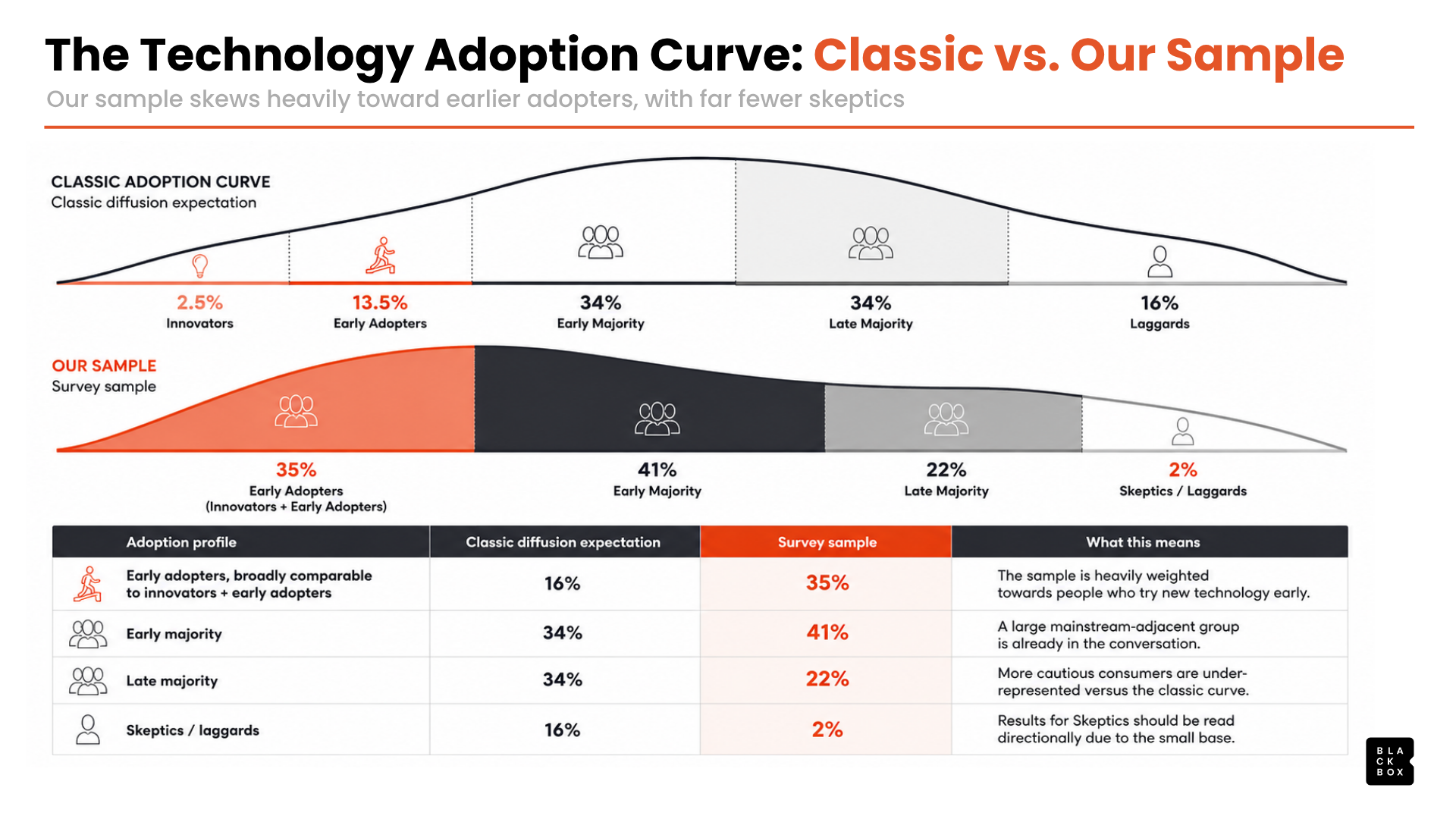
The visual below shows the classic adoption curve, first described by Everett Rogers in his work on the diffusion of innovations.
In our survey, respondents placed themselves on this curve by choosing the statement that best describes them: usually among the first to try new technologies (Early Adopters), adopting once they become more common (the Early Majority), waiting until technologies are well proven (the Late Majority), or avoiding new technology unless necessary (Skeptics). We refer to these four groups as the Adoption Segments. Our sample leans towards the tech-savvy end of the curve: Early Adopters and the Early Majority together make up 76% of respondents, against roughly half in Rogers’ classic distribution.
Source: Blackbox-Sumsub study. Sample total n=1,050. Skeptics n=24.
Where AI and AI Agents Are Now
Using AI as an assistant is one behaviour. Letting AI act on your behalf is another.
The first is already becoming normal. People are using AI to ask questions, generate content, compare options, plan activities and structure decisions. It helps them think, but leaves the final decision clearly with them.
The second requires more. Letting an AI agent book, buy, pay or make a financial decision means giving up a degree of control. That needs a different level of trust.
This is where the adoption story starts to split. Assistive AI and agentic AI may be travelling along the same broad path, but they are not moving at the same speed.
Table 1 (below) shows two gaps at once.
The first is between assistance and action: letting an agent act, book, buy or make decisions remains far less common than using AI to think.
The second is between the Adoption Segments, and it only really opens when agents start acting. On lower-risk thinking tasks, the segments look surprisingly similar. The Late Majority is just as likely as Early Adopters to have asked questions or generated content. But Early Adopters are six times more likely to have used agents inside another app, and three times more likely to have let AI make a purchase or financial decision.
AI Assistance is becoming everyone’s behaviour. AI Action still belongs mostly to the front of the curve.

Source: Blackbox-Sumsub study. Sample total n=1,050. Skeptics n=24. Multi-select responses may exceed 100%. ▲/▼ = significantly higher/lower than Total at 95% confidence. Skeptics (n=24) shown for directional reference only, not significance-tested.
The Autonomy Ladder
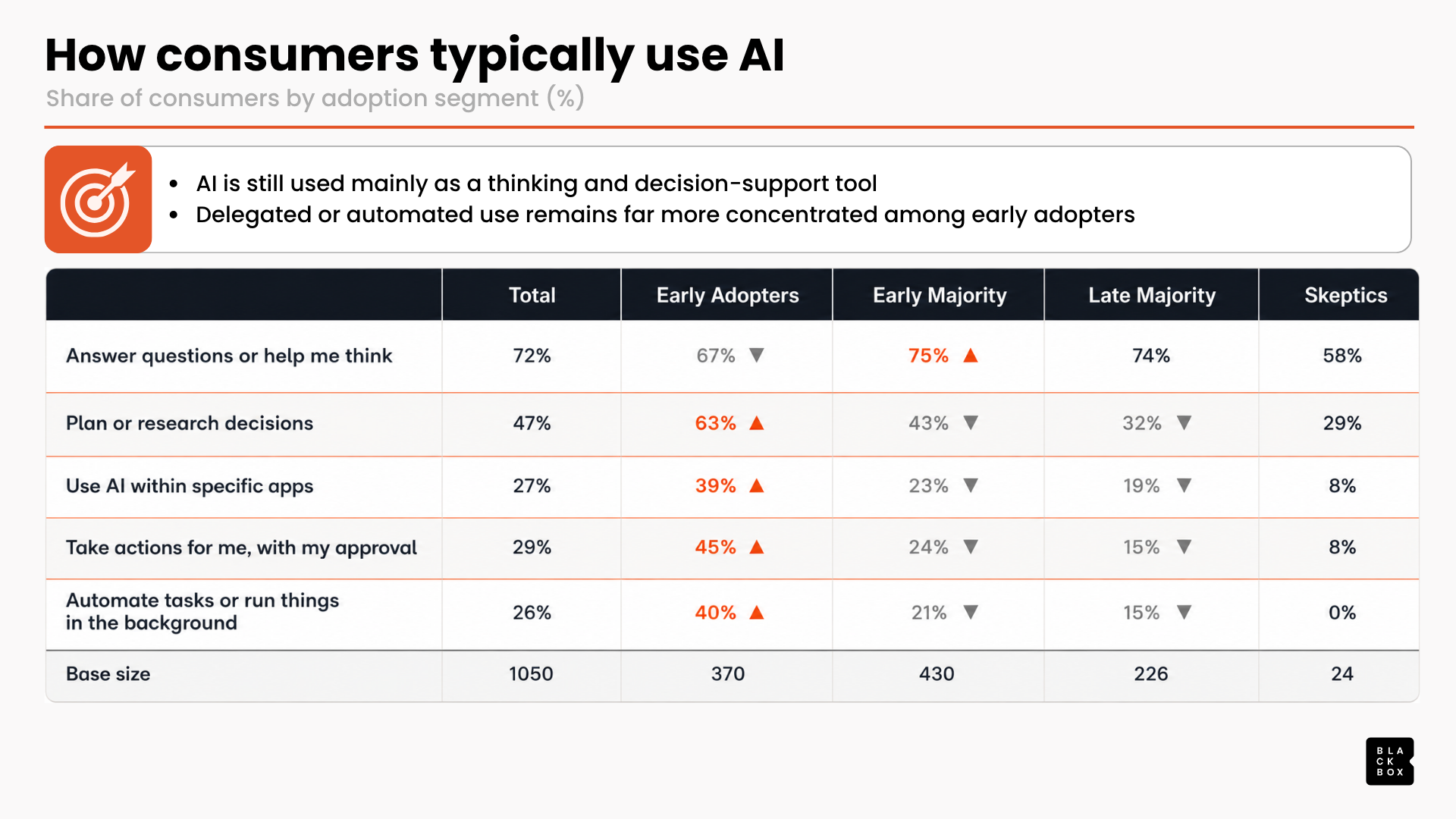
The same structure appears when people describe how they typically use AI.
Most people are still using AI close to the ground. 72% use it mainly to answer questions or help them think, and almost half, 47%, to plan or research decisions. From there, participation thins: 29% let AI take actions with their approval, and 26% let it automate tasks in the background. But those totals hide a sharp divide by adoption segment. Early Adopters sit higher on the ladder at every rung, while the Late Majority stays close to the ground — as willing as anyone to ask questions, but far more reluctant to let AI act or automate.
Source: Blackbox–Sumsub study. Sample total n=1,050. Skeptics n=24. Multi-select responses may exceed 100%. ▲/▼ = significantly higher/lower than Total at 95% confidence. Skeptics (n=24) shown for directional reference only, not significance-tested.
Each rung on this ladder asks the consumer to give up a little more control. Answering a question is low risk. Planning a decision is still relatively comfortable. Taking an action needs approval. Automating in the background requires trust that the system will do the right thing without being watched.
That is the real adoption challenge for AI agents. The issue is not whether people are interested in AI. Many already are. The harder issue is a behavioural question of whether they are ready to delegate.
In our survey, there was a small group who know about AI agents but do not use them. The top reason wasn’t some deep fear, but rather “seeing no need” and “not knowing where to start”.

Source: Blackbox–Sumsub study. Aware non-users n=84. Base: respondents aware of AI agents but not currently using them (n=84); shown for directional reference only, not significance-tested. Single-select.
This looks less like rejection and more like an onboarding problem.
People are not necessarily saying, “I will never use this.” They are saying, “I do not yet know where it fits, why I need it, or what I am comfortable letting it do.”
What This Means
The practical lesson I take from this is simple: using an AI agent does not necessarily mean someone is ready to delegate authority to it. For anyone building, marketing or regulating agentic products, awareness and usage metrics will flatter you. Permission metrics will tell you the truth.
The question worth tracking is not just whether someone has used an AI agent. It is what they allowed it to do.
Did they let it suggest?
Did they let it decide?
Did they let it act?
Did they let it spend money?
Did they want approval before the final step?
Those distinctions matter because they show where trust in AI is forming and where it still needs support. For AI agents, the next phase of adoption will not be driven by capability alone. It will be shaped by approval steps, limits, verification, clear escalation and a human to call when something goes wrong.
That is not a side issue. It is the condition of adoption.
The next two pieces in this series look at what shapes that permission: how consumers structure trust when agents can spend money, and what agent-mediated buying means for brands.
Click here to read part two.
Click here to read part three.
Ready to Make Agentic AI Work for You?
Reach out to Blackbox for a conversation on how our research solutions can help you build, market or regulate agentic products more effectively.