
SensingSG Q2 2026 Special Report: Singapore Welcomes AI, Even as Tech Fatigue Sets In
Singaporeans welcome AI’s practical value, but its adoption is unfolding in a society already fatigued by technology and uncertain about who will share the gains. New SensingSG data for Q2 2026 shows that public confidence will depend less on persuading people to accept AI than on making work simpler, transitions fairer and the benefits more broadly felt.
AI is already improving everyday life for most Singaporeans
Resistance to AI itself is not the central issue. Sixty-three per cent of Singaporeans say AI tools and large language models have improved their quality of life over the past year, compared with just 10% who say they have made it worse. The remaining 27% report no meaningful change or hold a neutral view.
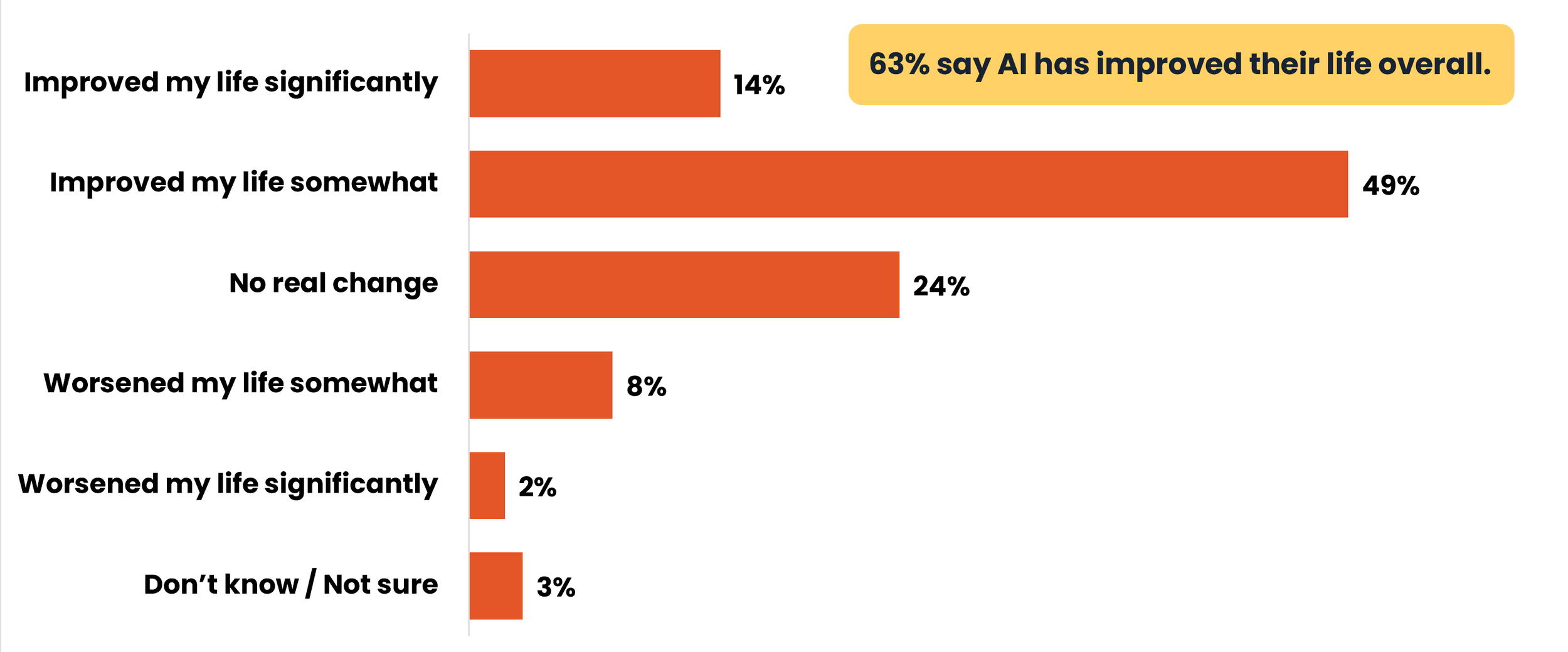
How has the increasing availability of AI tools affected your quality of life?
SensingSG data, Jul 2026, n=1533, nationally representative sample of Singaporeans and PRs, 21+.
These findings provide a strong foundation for further adoption. Singaporeans already recognise what AI can do when it saves time, improves access to information or makes an everyday task easier.
The challenge arises when AI moves from tools people choose to use into systems introduced by employers and institutions. Personally selected tools can feel empowering. Workplace technology can produce a very different response when it adds another interface, process or expectation without removing any of the existing workload.
AI adoption is rising within a technology-weary workforce
Three in four Singaporeans experience some degree of technology fatigue. Thirty-one per cent encounter it always or frequently, while another 44% experience it occasionally. Only 25% say they do not experience technology fatigue.
This exhaustion is cumulative. Constant notifications and continuous software retraining are the two leading causes, each cited by 39% of respondents. Password management follows closely at 38%, while 35% feel pressure to keep pace with AI-driven automation.
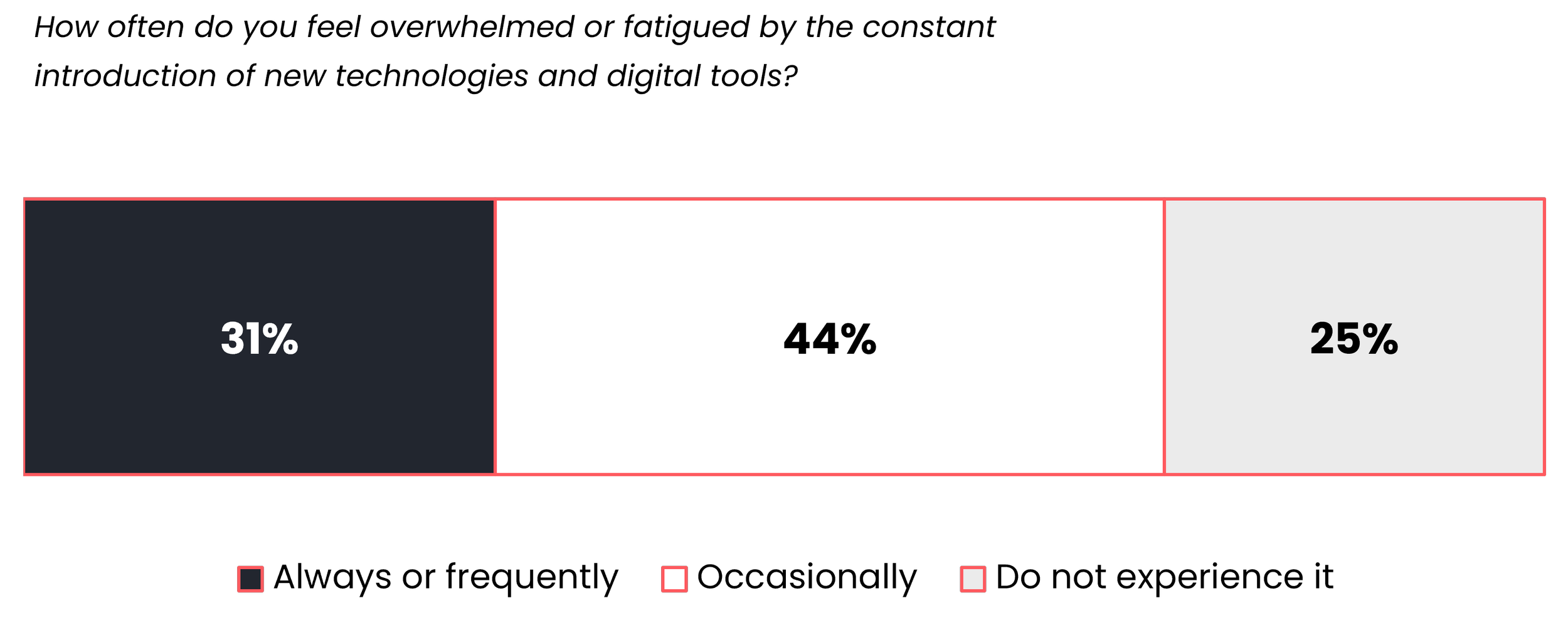
SensingSG data, Jul 2026, n=1533, nationally representative sample of Singaporeans and PRs, 21+.
Digital fatigue therefore cannot be attributed to one transformational technology. It develops through repeated interruptions, fragmented systems and the continual need to relearn how work gets done.
For employers, this changes the productivity calculation. Adding an AI assistant to an already crowded technology stack may create another source of administration rather than genuine efficiency. The most useful test is whether a new system removes work, reduces interruptions and simplifies decisions.
Policymakers face a related challenge. Workforce readiness cannot be assessed solely through access to courses or the number of workers trained. Cognitive load, implementation quality and the everyday experience of technological change also affect whether people can adapt successfully.
Earlier digital eras represent a desire for greater control
Only 19% of Singaporeans prefer today’s hyper-connected technological environment. By comparison, 31% favour the 2010s and 25% prefer the 2000s.

SensingSG data, Jul 2026, n=1533, nationally representative sample of Singaporeans and PRs, 21+.
This preference should not be read as a rejection of technological progress. It reflects a desire to recover qualities people associate with earlier digital eras: fewer interruptions, clearer boundaries, more focused work and greater separation between professional and personal life.
The implications extend beyond employee wellbeing. Technology introduced into an already fatigued workforce may encounter slower adoption, shallow usage or quiet workarounds, even when employees recognise its potential value.
AI adoption will therefore be judged partly by whether it restores a sense of control. Systems that reduce repetitive work and consolidate fragmented processes are likely to earn acceptance. Those that create more alerts, dashboards and after-hours expectations will deepen existing fatigue.
Career anxiety is highest among those expected to adapt fastest
Fifty-two per cent of Singaporeans are concerned about AI’s effect on their career prospects. Among those aged 21 to 29, concern rises to 60%.
Younger professionals may be digitally fluent, but that does not make them economically secure. Many are entering the workforce as entry-level responsibilities, training opportunities and traditional career pathways are being redesigned.
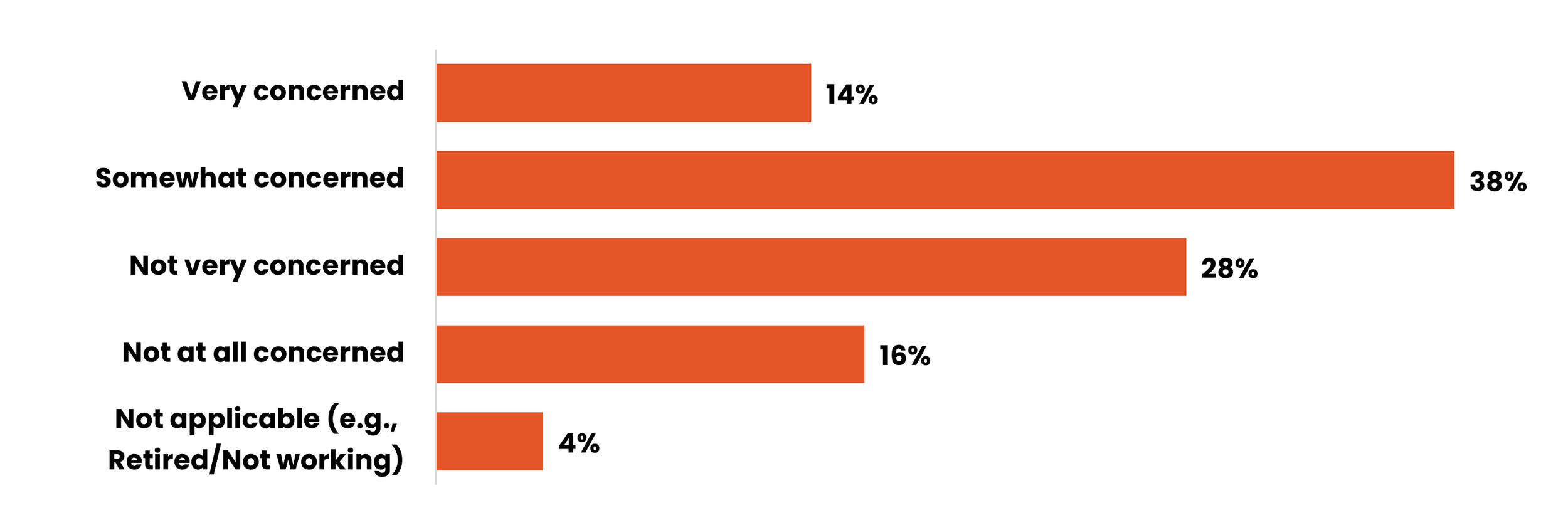
How concerned are you that AI could negatively impact your job or career prospects in the next few years?
SensingSG data, Jul 2026, n=1533, nationally representative sample of Singaporeans and PRs, 21+.
This raises questions that generic encouragement to “embrace AI” cannot answer. Younger workers need to know which foundational experiences will remain available, how junior roles will develop and what progression looks like when more routine tasks are automated.
Employers need credible answers about how early-career positions will evolve. Policymakers must also ensure that AI-enabled productivity does not weaken the entry points through which younger workers acquire judgement, experience and professional confidence.
Singaporeans fear that AI’s gains will be unevenly distributed
The strongest concerns centre on fairness. Seventy-two per cent expect older workers to be left behind, 71% believe companies will benefit more than employees and 69% expect the skills gap to widen.
These findings reveal a public that sees technological progress as possible, but does not assume its benefits will be shared automatically. Confidence will weaken if AI becomes associated primarily with corporate savings while workers absorb the uncertainty, retraining burden and risk of displacement.
Singapore’s policy response increasingly recognises this employment dimension. The Government has committed more than S$400 million to the Enterprise Workforce Transformation Package, while the planned Tripartite Jobs Council is intended to coordinate action on AI’s effects on workers, jobs and businesses. Ministry of Manpower, Tripartite Jobs Council
The next test is whether these initiatives produce outcomes people can see: redesigned jobs, stronger career pathways and access to better work after training.
Optimism about upskilling remains conditional
Singaporeans have not given up on adaptation. Seventy per cent believe upskilling can help workers adjust to AI, 66% say relevant training is available and 64% trust the Government to support the workforce transition.
Yet 61% also believe existing measures are insufficient.
These results are not contradictory. Singaporeans can recognise that support exists while questioning whether it is sufficiently targeted, accessible or connected to real employment opportunities. Training is only one part of the transition. Workers also need access to relevant tools, opportunities to apply new capabilities and a clear route into redesigned roles.
This helps explain why 65% say it is still too early to determine whether AI’s overall effect will be positive or negative. The public has seen enough to recognise AI’s potential, but not enough to know how the gains and disruptions will ultimately be distributed.
Income already shapes whether AI feels like opportunity or disruption
The sharpest divide appears across income groups. Among high-income respondents, 79% say AI has improved their lives, compared with 53% of lower-income respondents.
The same gap extends to future opportunity. Seventy-two per cent of high-income respondents believe AI will create better jobs, compared with 41% of those on lower incomes. Confidence in upskilling also stands at 82% among higher-income respondents and 65% among lower-income respondents.

SensingSG data, Jul 2026, n=1533, nationally representative sample of Singaporeans and PRs, 21+.
Those benefiting most are not necessarily satisfied with the transition, however. Seventy-one per cent of high-income respondents consider current support measures insufficient, compared with 49% of lower-income respondents.
This suggests that concern is informed by more than personal insecurity. People with greater exposure to AI may also have a clearer view of the scale and speed of the changes ahead.
Training alone will not close these divides. Lower-income and vulnerable workers also require access to effective tools, redesigned roles and career pathways that turn new capabilities into tangible employment outcomes.
Singapore’s AI transition will be judged by how it feels and who benefits
Singapore already has substantial policy infrastructure for responsible AI adoption, including the National AI Impact Programme, workforce transformation support and governance frameworks for emerging AI systems. IMDA
SensingSG reveals the social test facing these efforts. People want useful technology, simpler working lives and credible opportunities to progress. They also want confidence that older, younger and lower-income workers will not carry a disproportionate share of the disruption.
The paradox lies between individual utility and collective conditions. Singaporeans welcome what AI can do, while questioning the strain surrounding its introduction and who will ultimately share in its gains.
Wait, there’s more…
View the fully interactive and freely accessible SensingSG dashboard here
Read our briefing on this quarter’s public sentiment towards the national economy, personal finances, government performance, and a wide range of other issues.