
The Orbital Pivot: Why Singapore is Betting on Space Logistics, Not Rocket Science

An Op-Ed by David Black
(Founder and CEO of Blackbox Research)
In recent years, space has quietly shifted from a niche technical frontier to a new operating layer for the international economy and global security, even if AI currently dominates the headlines. Satellite constellations now underpin everything from broadband connectivity and financial transactions to precision logistics, climate monitoring, and zero-gravity laboratory tests. Even resource extraction on the moon now beckons.
At the same time, the domain above Earth has become militarily contested, with major powers treating space infrastructure as both a critical asset and a potential vulnerability. Satellite technology is now essential to "hit and run" raids as well as battleground manoeuvres and management, as seen in Ukraine. This dual-use character explains why governments and investors are finally treating space policy as less about exploration and more as a vital infrastructure consideration for the 21st century.
The 2026 Inflection Point
Evidence points to 2026 being a turning point for the space business. SpaceX is weighing a mid-2026 IPO that could value it at US$1.5 trillion, formally launching space as a mainstream asset class and an exciting new vertical. Others in Silicon Valley who missed the AI boom will likely follow.
Rocket Lab, the New Zealand upstart that first achieved orbit in 2017, has built a repeatable launch business and is layering in its partially reusable Neutron rocket, expected to go live in 2026 alongside its Electron small-sat launcher. Together, these developments signal that space is evolving into a realistic frontier business category with multiple customer segments—from Earth observation to defence and data infrastructure—rather than just breathless visions of sending humans to Mars.
Singapore’s Strategic Move
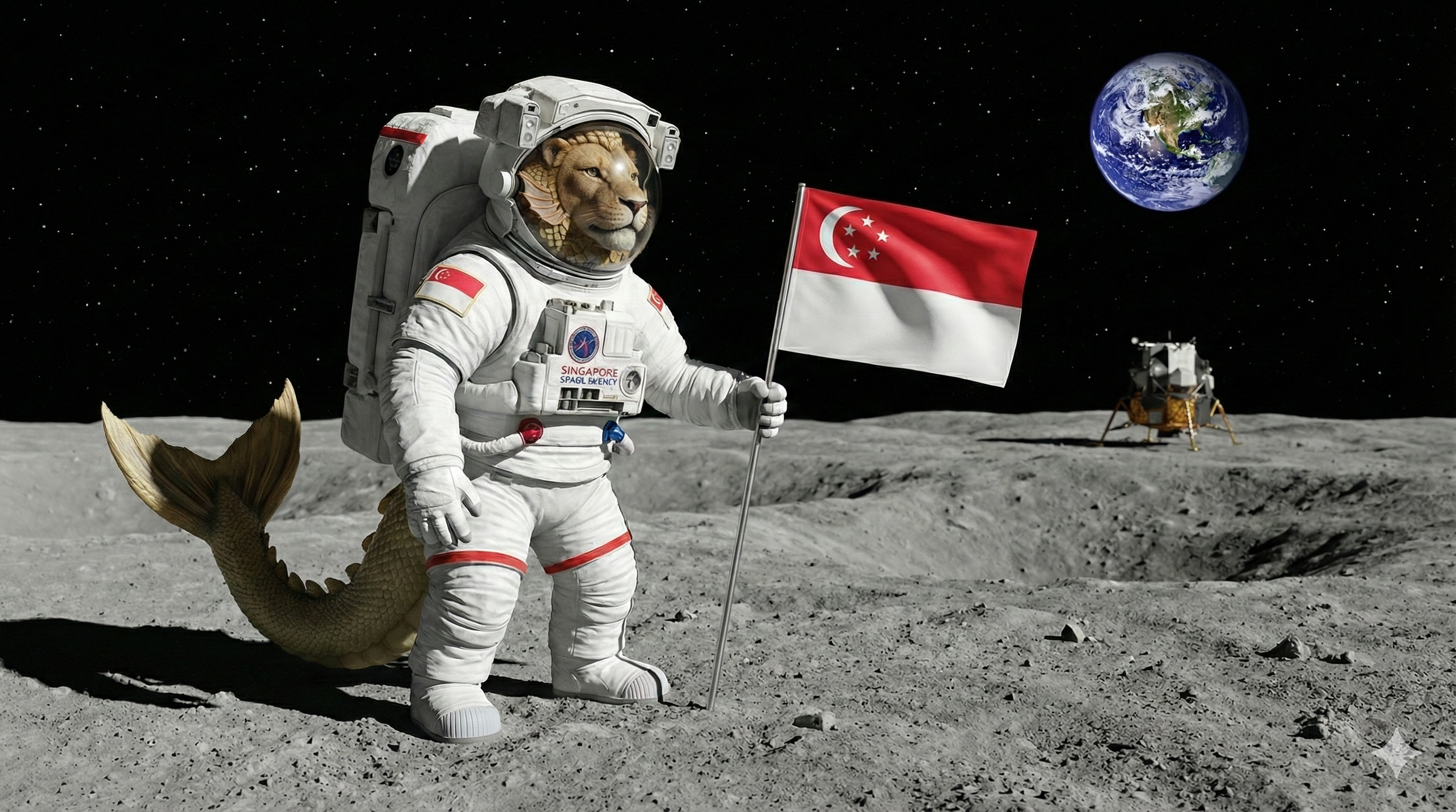
Against this backdrop, Singapore has announced the establishment of the National Space Agency of Singapore (NSAS), to be launched on 1 April 2026, under the Ministry of Trade and Industry (MTI). The Government frames NSAS as helping Singapore become a "credible contributor" to the global ecosystem and harness the projected US$1.8 trillion global space economy by 2035.
Today, Singapore already hosts about 70 space companies employing around 2,000 professionals across activities from component design to satellite-based services. It has also built partnerships with agencies such as the ESA (Europe), IN-SPACe (India), and the UAE Space Agency. As such, this week’s announcement caps a decade of quiet ecosystem building.
NSAS’s mandate points to a broad, whole-of-nation approach. It will develop national space capabilities, including a constellation of co-owned Earth Observation satellites, a multi-agency operations centre for satellite tasking, and space situational awareness capabilities. It will also invest in R&D, grow the local industry, and craft pro-innovation national space legislation. The appointment of Ms Ngiam Le Na as founding Chief Executive underscores a strong technocratic and defence-tech orientation; she has previously led Earth Observation satellite acquisition and counter-drone efforts.
Can Singapore Compete?
The competitive challenges are stark. Rocket Lab reached orbit in 2017 and has since executed frequent commercial and government launches. By contrast, Gilmour Space Technologies—a key Australia-Singapore-linked player—remains several generations behind in demonstrated orbital capability and launch cadence.
This gap highlights a common-sense approach for Singapore: it appears less keen on "me-too" vertical launch competition and is instead looking at niche strengths in space logistics, services, and downstream applications. Singapore comes to the table with a deep engineering and services base, including an aerospace ecosystem featuring Singapore Airlines and ST Engineering. NSAS plans to leverage adjacent domains—AI, robotics, and quantum technologies—as enablers of space capabilities.
“If policy, capital, and talent are aligned behind a few globally ambitious players, there is no reason why an “SG-Space” brand cannot emerge over the coming decade. This would echo the disciplined, service-centric model that made SIA the world-class operator it has become. ”
Will NSAS Create the "Singapore Airlines" of the Stars?
So what can Singaporeans realistically expect in the near future? It will not necessarily be the "sexy" stuff.
Visible Space Data: First, expect more visible use of space data in everyday policy domains—better climate resilience, enhanced maritime awareness, and smarter urban planning powered by geospatial analytics.
High-Value Employment: Second, look for gradual growth in high-value jobs across satellite services, data analytics, and in-orbit technology testing, building on the current base of 2,000 professionals.
Regulatory Clarity: Third, clearer regulatory pathways via national space legislation will show how 21st-century innovation can be balanced with safety and sustainability, offering investors and talent a visible roadmap.
Whether Singapore can build a "space equivalent" of Singapore Airlines—a globally recognised, high-prestige brand—is ultimately a strategic choice. NSAS’s current mandate leans toward being an orchestrator and capability anchor for a broader ecosystem, not the operator of a single flagship champion.
But if policy, capital, and talent are aligned behind a few globally ambitious players, there is no reason why an "SG-Space" brand cannot emerge over the coming decade. This would echo the disciplined, service-centric model that made SIA the world-class operator it has become.
As a final note: it is never wise to bet against Singapore when it comes to building world-class logistics. It has been successful at it for a long time.