
Singapore–JB RTS Link: Why Singapore Needs a Two-City Strategy
Is Singapore Thinking Too Small About Its Future With JB?
An Op-Ed by David Black, Founder and CEO of Blackbox Research
The RTS Link will expose how much of Singapore’s consumer economy has been protected by inconvenience. Blackbox’s latest research shows that Singaporeans are ready to cross more often, shift routine spending and use JB for healthcare, leisure and short stays, which leaves Singapore with one clear task: become harder to substitute.
The problem is structural price difference; the insight is that smoother travel converts savings into habit; the action is to stop subsidising sameness and create room for experiences, operators and business models people cannot find elsewhere. The public appears more comfortable with that argument than many of the institutions speaking on its behalf.
The Causeway Queue Was Doing More Economic Work Than We Cared to Admit
For years, congestion has acted as an unofficial tariff on going to JB.
Singaporeans could see the savings. They simply had to decide whether those savings justified traffic jams, immigration queues and an unpredictable journey home.
The RTS Link is designed to remove much of that calculation. The official journey between Woodlands North and Bukit Chagar will take approximately five minutes, while co-located immigration facilities mean travellers clear both countries’ authorities before departure. Passenger service is targeted to begin at the end of 2026.
Once the friction falls, behaviour changes.
In our July 2026 survey, 76% of Singaporeans said they were likely to use the link during its first year. Nearly six in ten expected to visit JB more frequently than they do now. More than half could see themselves buying groceries, dining or shopping there at least once every three months, while 43% could imagine staying overnight on a similarly regular basis.
Those figures do not describe an occasional escape. They describe JB entering the weekly and monthly rhythm of Singaporean life.
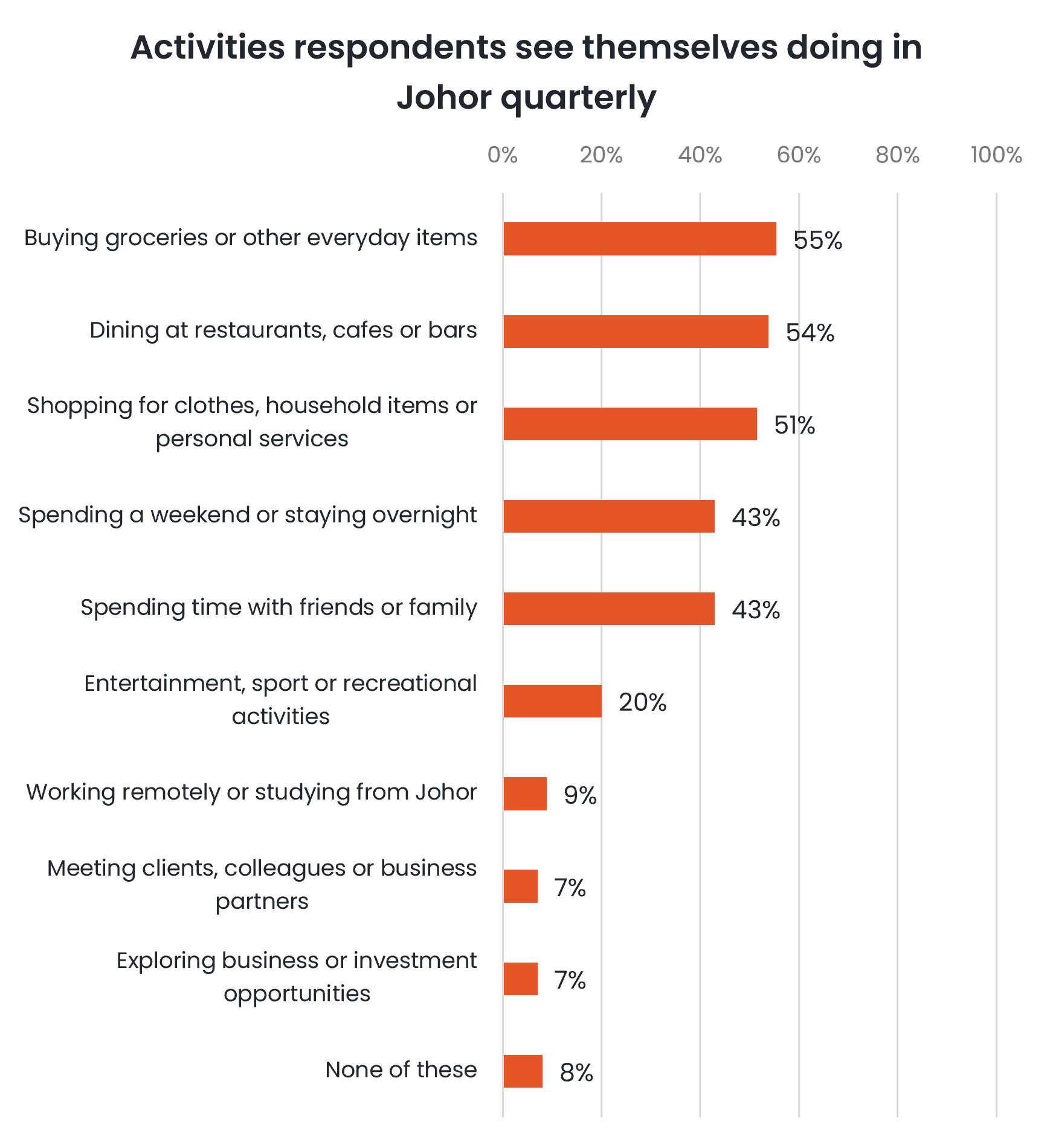
Blackbox Research RTS Link Survey (July 2026). Base: Overall (n=507). If travelling between Singapore and Johor does become quick and predictable, which of the following could you realistically see yourself doing in Johor at least once every three months?
A separate study - jointly commissioned by the Singapore Business Federation, Restaurant Association of Singapore and Singapore Retailers Association - projects that the RTS Link will generate an additional 11.2 million Singapore-to-JB round trips annually.
That is the real disruption. The RTS is turning cross-border consumption from an outing into a habit.
The First Commercial Shock Will Hit Ordinary Purchases
Nearly nine in ten respondents named some amount of monthly spending that could move from Singapore to Johor. Seventy-four percent indicated at least S$100, 32% at least S$250 and roughly one in ten S$500 or more.
The estimated average was close to S$250 every month.
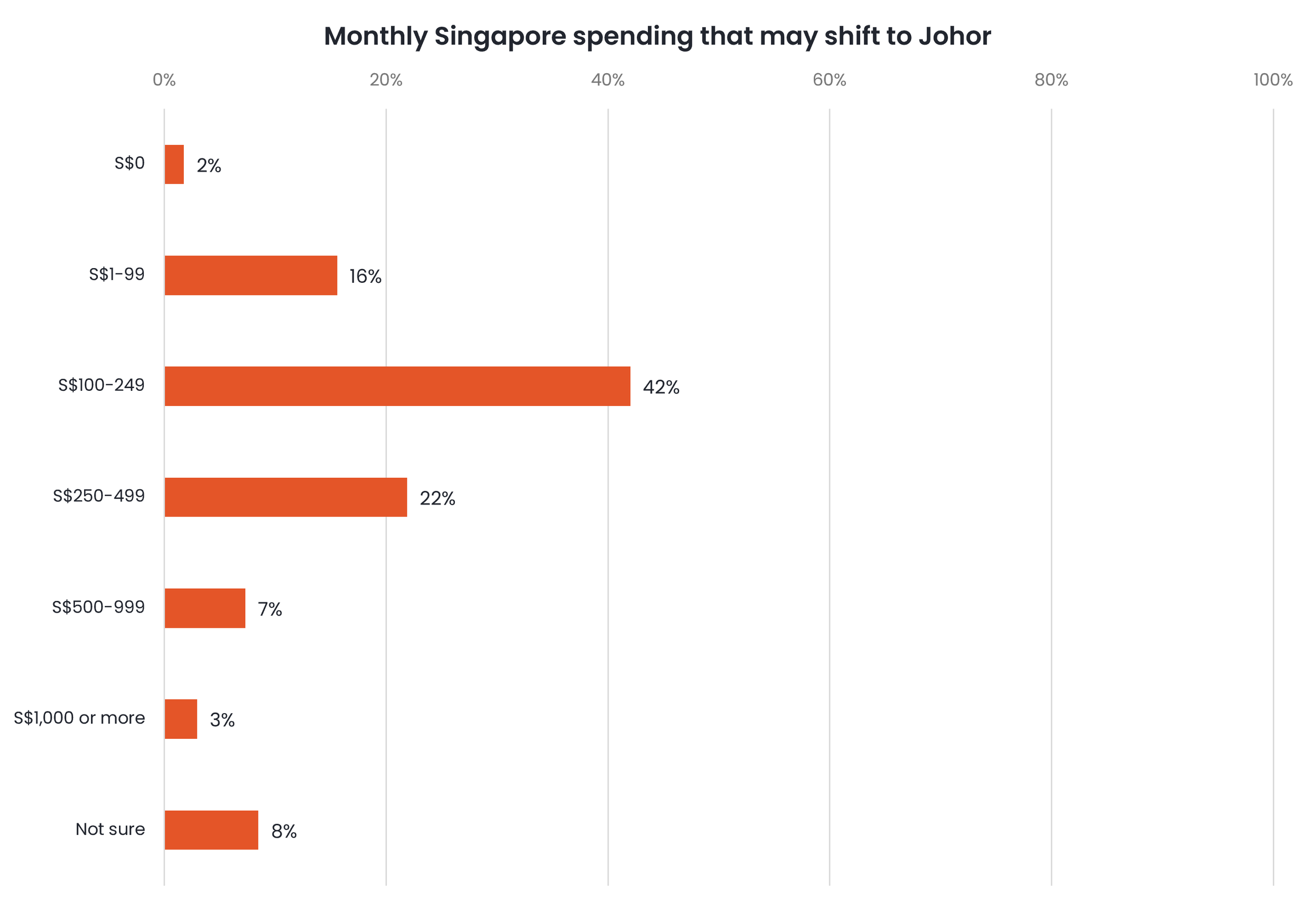
Blackbox Research RTS Link Survey (July 2026). Base: Overall (n=507). Thinking about shopping, groceries, dining, entertainment, personal services and leisure, approximately how much of the money you currently spend in Singapore might you instead spend in Johor in an average month?
The first money to move will be highly familiar: groceries, clothing, casual meals, beauty products and personal services. These are purchases where the value difference is visible, frequent and relatively easy to compare.
No shopping festival can eliminate that arithmetic. No voucher can permanently erase the structural differences in land, labour, rent and operating costs.
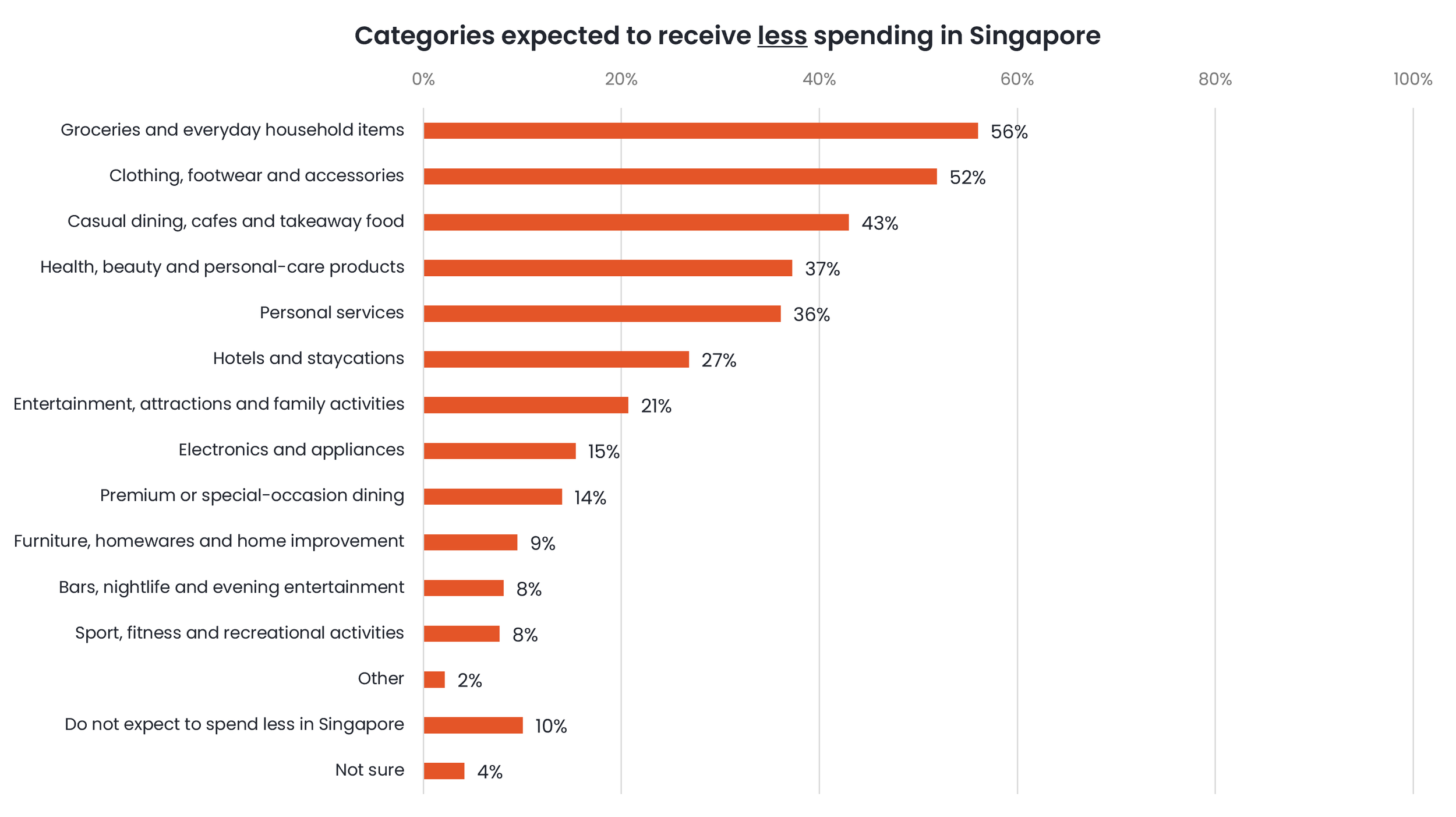
Blackbox Research RTS Link Survey (July 2026). Base: Overall (n=507). Following the RTS Link opening, which of the following, if any, do you expect to spend less money on in Singapore because you will instead buy or experience in Johor?
The headline from the SBF/RAS/SRA study is that Singaporeans could spend an additional S$1.05 billion in JB each year (but our data, while directional only, suggests this could be conservative). JB visitors are also expected to add S$756 million of spending here, leaving a net incremental outflow of roughly S$290 million, or 0.4% of Singapore’s 2025 retail and F&B sales.
At sector level, 0.4% is manageable. For a thin-margin independent grocer, beauty operator or casual restaurant sitting directly in the path of substitution, the experience may be far less comfortable.
The risk is concentrated, which means the response must be targeted. Treating the entire economy as though it faces an existential crisis encourages expensive, blunt solutions while leaving the most exposed businesses without a credible route to adaptation.
Mid-Career and Higher-Income Consumers Will Drive the Shift
The convenient caricature is a young bargain hunter heading north for cheap cafés and a manicure.
Our data does not support it.
Only 29% of respondents aged 18 to 34 expect to shift at least S$250 a month. The figure rises to 43% among those aged 35 to 44 and sits at 37% among 45- to 54-year-olds.
Income tells a similar story. Among employed respondents earning S$7,000 or more, 51% expect to move at least S$250 of monthly spending to Johor.
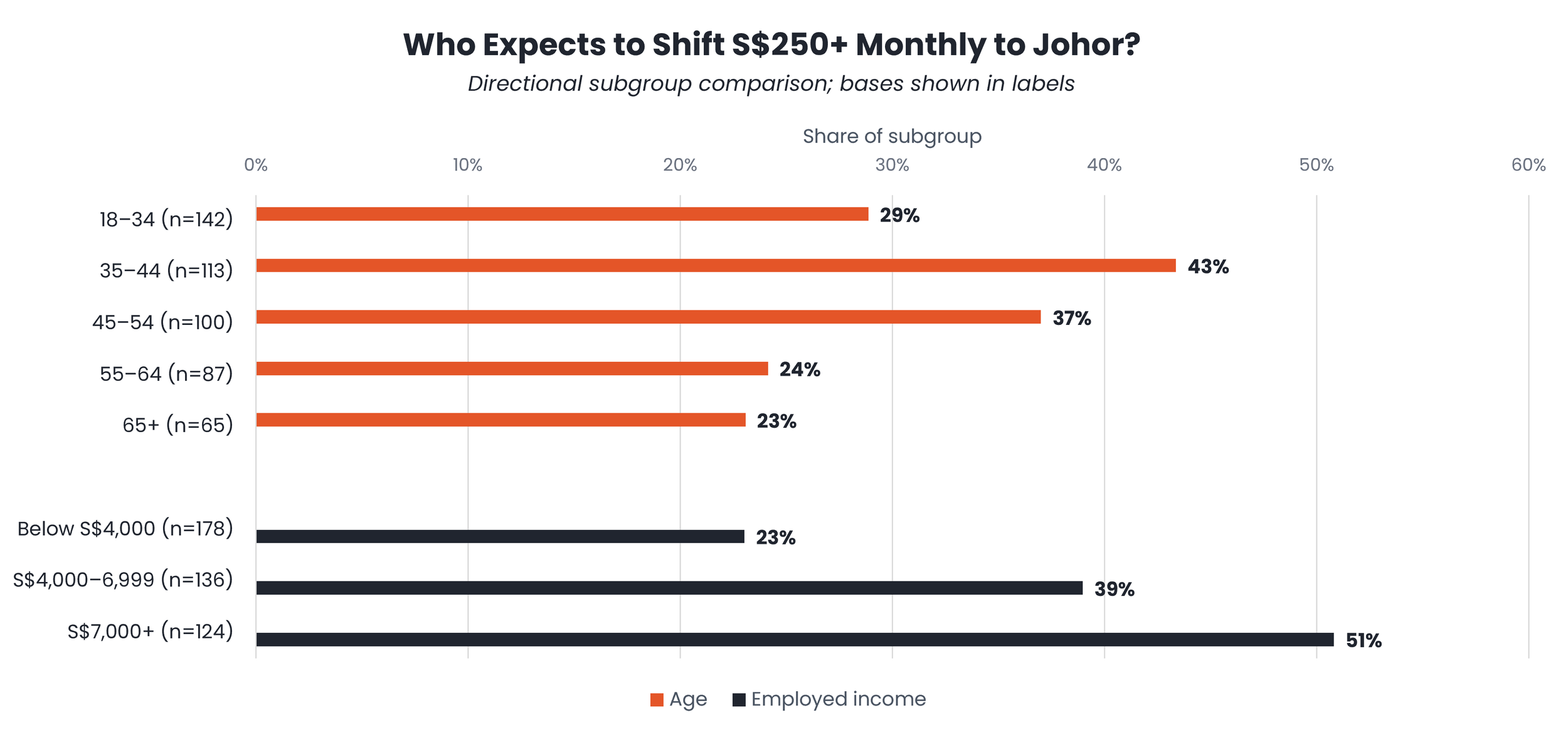
The greatest commercial threat may come from established consumers with cars, families, purchasing power and a long list of recurring expenses.
This doesn’t mean they are abandoning Singapore, but they are planning on optimising across a larger market.
That distinction matters. Businesses cannot depend on patriotism, inertia or inconvenience to protect a weak value proposition.
Casual F&B Is Exposed, While Distinctive Experiences Have Room to Win
The dining results should make Singapore’s F&B sector pay attention.
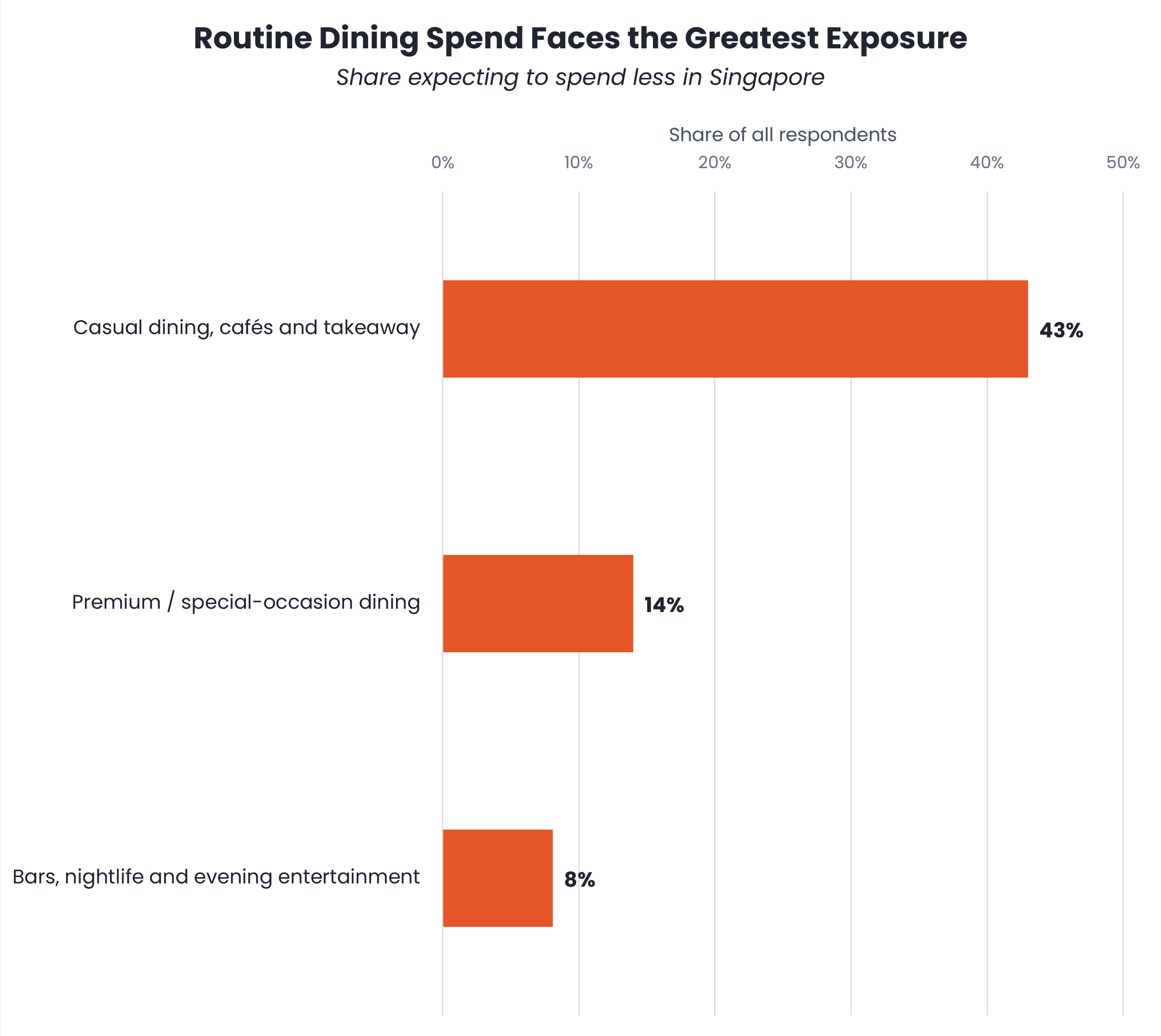
Some 43% expect to reduce spending on casual dining, cafés and takeaway food in Singapore once travelling to JB becomes easier. Only 14% say the same about premium or special-occasion dining. For bars and nightlife, the figure falls to 8%.
The weakness sits in routine, interchangeable consumption.
This is uncomfortable because Singapore has built an enormous amount of commercial space around safe repetition: familiar menus, familiar tenants, familiar mall formats and familiar promotions. When the same basic experience is available in JB at a meaningfully lower price, familiarity stops being a moat.
Everyday operators need sharper products, better convenience and a stronger place in their customers’ routines. Premium operators need to become more memorable, culturally relevant and difficult to copy.
A night-time economy that closes early, struggles with transport or makes experimentation commercially painful is wasting one of the categories that appears least vulnerable to cross-border leakage.
Singapore does not need every restaurant to become expensive. It needs more restaurants, shops and entertainment concepts with a reason to exist beyond convenience and habit.
When the same basic experience is available in JB at a meaningfully lower price, familiarity stops being a moat.
The Public Has Already Moved Beyond Fortress Thinking
Singapore’s institutional reflex often begins with protection: how much spending will leave, which firms will suffer, and which support scheme might soften the impact.
Singaporeans themselves sound more pragmatic.
Thirty-two percent of our respondents said they felt more excited than worried because easier movement could create a more interesting two-city region. Another 31% were primarily interested in reducing their own household costs through cheaper food, shopping, leisure and services.
Only 21% preferred the defensive position that Singapore should concentrate on protecting spending and activity at home. Sixteen percent had mixed feelings.
Our separate SensingSG study found that 53% regarded the RTS-driven increase in connectivity as an opportunity, compared with 22% who saw it mainly as a threat.
Blackbox Research, SensingSG (July 2026). Base: Overall (n=1533). Over the next two years, the easing of cross-border travel via the completed Singapore-JB RTS Link will occur. Do you view this hyper-connectivity primarily as an opportunity or a threat?
This optimism does not come from naivety. Johor was also named as Singapore’s strongest long-term regional business competitor, narrowly ahead of Kuala Lumpur.
Singaporeans can see the competitive challenge clearly. They still prefer to engage with it.
The public is giving policymakers and businesses permission to compete confidently. We should take it.
JB Is Becoming a Lifestyle Platform Beyond the Weekend Trip
The next stage of integration will move beyond groceries, cafés and shopping malls.
Fifty-eight percent of our respondents would consider using routine health services in Johor. Almost half would also consider renting a property for weekends or occasional stays.
The appetite for permanent commitments is more measured, although far from trivial. About a third would consider regular renting, buying for family use or purchasing as an investment.
Blackbox Research, RTS Link Survey (July 2026). Base: n=507. If travelling between Singapore and Johor does become quick and affordable, how likely would you be to consider doing each of the following during the next three years?
Younger adults are particularly open. Half of those aged 18 to 34 would consider buying property for themselves or their family, and the same proportion would consider buying as an investment.
The RTS therefore reaches into healthcare, insurance, housing, employment, tourism and family life.
Calling this a retail-leakage issue is like calling Changi Airport a runway project. It misses the economic system that will form around the infrastructure.
Singapore’s Safe-Mall Formula Is the Real Vulnerability
The Government has a role, although endlessly cushioning existing formats will leave Singapore less prepared.
Support should fund change.
We need shorter and more flexible leases. Faster licences for experimental concepts. Affordable test spaces for first-time operators. Rules that allow food, retail, culture and entertainment to coexist. Late-night transport that gives evening businesses a realistic chance of surviving.
We also need landlords willing to accept a little disorder.
Commercial property strategies built around predictable rents and proven tenants have produced precisely what they were designed to produce: predictable malls. That model becomes fragile when consumers can reach a cheaper version of the same experience in minutes.
Singapore should be inviting emerging chefs, retailers, designers and entertainment operators from Malaysia and the wider region to test concepts here. The ambition should extend beyond waiting for another established American, Chinese, Japanese or Korean chain to occupy another carefully curated unit.
Originality always carries risk. So does becoming boring.
Mega-Events Create Spikes; Everyday Magnetism Creates Loyalty
Concerts, sporting events and major festivals matter. They fill hotels, attract visitors and generate global attention.
They are moments, rather than an operating system.
A city becomes compelling when people regularly encounter something new: a restaurant, performance, neighbourhood, market, shop or idea that appeared because somebody had the room to experiment.
That requires tolerance for noise, failure and churn. Vibrancy does not always arrive on an approved activation calendar.
Singapore cannot purchase everyday magnetism from a global touring schedule. It has to create the commercial and cultural conditions from which magnetism grows.
Johor Cannot Be Reduced to Singapore’s Cheap Back Room
Johor is entering this relationship with its own confidence.
In our pre-election research among undecided Johor voters, 96% believed the state was moving in the right direction. Seventy percent regarded data centres as an important source of future growth, while 74% expected the RTS to benefit Johor residents.
Johor increasingly sees itself as an investment destination and emerging economic centre, rather than Singapore’s cheaper neighbour.
Its confidence comes with a warning. Cost of living was the leading concern in our survey. Eighty-six percent expected everyday issues such as prices and jobs to decide the election, while 82% believed voters were thinking about the arrival of more Singaporeans after the railway opens.
Singapore fears that money will leave. Johor fears that Singaporean money will arrive without producing better lives for Johoreans.
A viable two-city region must answer both concerns.
Singapore businesses can use Johor for production, central kitchens, workshops and new customer experiences. Malaysian brands can use Singapore as a regional test market and international showcase. Entrepreneurs can build services around people who live, work, shop and socialise across both cities.
The old assumption that Singapore will retain every sophisticated activity while Johor supplies land and labour deserves to be retired. It lacks political durability and commercial imagination.
The Hong Kong–Shenzhen relationship is an imperfect comparison, but its underlying logic is useful. The strategic question was never limited to preventing Hong Kong residents from spending in Shenzhen. It also concerned how each city could remain valuable inside a larger economic system.
Singapore should ask the same question.
The Train Will Create a Region. Policy Must Decide What Kind
The RTS Link gives Singapore a Changi-scale strategic choice.
We can spend years counting how many dollars crossed the border, issuing temporary relief and wondering why familiar businesses remain vulnerable. Or we can decide what Singapore should become when JB is no longer psychologically or economically distant.
The second choice demands more from government, landlords, businesses and investors. It requires public policy, business intelligence and urban strategy to work together.
It also offers more.
Singapore’s future with JB will be decided by the value it creates from proximity: better businesses, greater choice, regional entrepreneurship and experiences that strengthen both sides.
The public is already preparing for that future.
Singapore should stop preparing for the past.
Research note: RTS Pulse Survey, July 2026, n=507 Singapore adults aged 18 and above. SensingSG July 2026, n=1,533. Subgroup comparisons are descriptive and directional unless significance is stated. Findings measure intended behaviour under favourable service-reliability and border-clearance conditions, rather than realised post-opening behaviour.
A version of this Op-Ed was first published on Blackbox’s Substack page.