
The Art of Storytelling With Data: Turning Numbers into Narratives

Organisations create more value from data when they convert it into clear meaning and practical decisions. In Asia’s digital economy, leaders need insight they can interpret quickly, align around internally, and use with confidence.
Many organisations have access to more data than ever before. Dashboards, syndicated reports, and real-time signals are now part of everyday decision-making across Asia’s digital economy. Even so, acting confidently remains difficult when the numbers are fragmented, overly technical, or disconnected from the decisions leaders need to make.
From Blackbox’s work in digital economy and consumer intelligence, one pattern appears consistently: organisations that move decisively are able to translate data into narratives that are clear, credible, and action-oriented. When insight is structured in a way that people can understand and apply, it becomes easier to set priorities, build alignment, and make better decisions.
"Data are just summaries of thousands of stories - tell a few of those stories to help make the data meaningful."
— Chip Heath
This article outlines three principles that distinguish data storytelling that drives decisions from data reporting that simply fills slides.
1. Context Is the Oxygen That Data Cannot Breathe Without
The Problem
Numbers without context are noise. A 12% drop in purchase intent is alarming or entirely expected depending on whether you know that a competitor just slashed prices, that a category-defining scandal broke last week, or that your audience has quietly migrated to a new platform. Data stripped of its surrounding environment leads to exactly the kind of confident misdiagnosis that sets strategies back by a quarter.
Why Asia Makes It Harder
In Asia, this challenge is amplified by the sheer velocity of change. Consumer sentiment in markets like Indonesia, Vietnam, and Thailand can shift materially within weeks in response to platform trends, influencer cycles, or macroeconomic signals. A data point captured without regional and cultural calibration is not just incomplete, it can be actively misleading.
How to Fix It
Build context into the data architecture from the start. Every insight delivered to a decision-maker should carry three layers: what happened, what was happening around it, and what it likely means for the trajectory ahead. Treating these as optional annotation rather than structural requirements is where most insight functions fall short.
Blackbox: Case in Point
In Blackbox's Retail Realities report, we found that Singapore shoppers exist within a 65/35 online-offline equilibrium, a split that only reveals its strategic logic when examined alongside behavioural drivers like digital fatigue, tactile preference, and the rise of "15-minute city" suburban retail. Without that surrounding context, the number alone tells brands almost nothing about where to invest next. This is precisely why multi-layered contextual research, rather than surface-level metrics, is the foundation of sound strategy.
2. The Narrative Arc: Data Has a Beginning, Middle, and End
The Principle
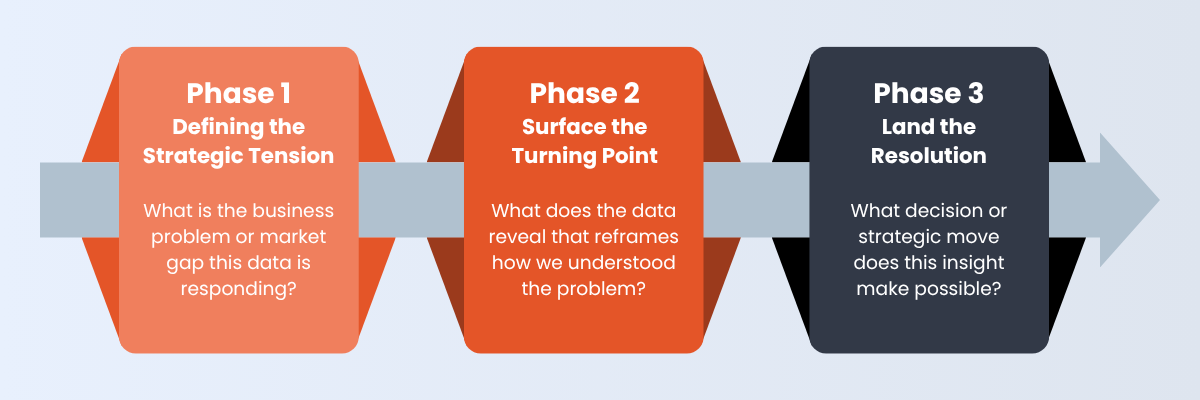
The most effective insights presentations are built on narrative structure. A clear arc, tension, turning point and resolution, helps decision-makers absorb complex findings and turn them into action. When data is delivered as a sequence of disconnected facts, the burden of interpretation falls on the audience. A well-shaped story closes that gap by showing what matters, why it matters, and what should happen next.
The Commercial Cost of Ignoring It
Research investment is wasted at the last mile more often than any other point in the process. A study that took months to design, field, and analyse can be ignored entirely if its findings aren't presented in a way that maps to how leaders make decisions under pressure. The difference between insights that drive action and insights that collect digital dust is almost always narrative structure.
"The goal is to turn data into information, and information into insight." — Carly Fiorina
Where to Start
Assign editorial responsibility alongside analytical responsibility. The person building the dataset is rarely the same person who should be crafting the narrative. Build a stage in your insights process specifically for transforming outputs into a decision-ready story with a clear protagonist (the business), a clearly defined challenge, and an unambiguous call to action.
Blackbox: Case in Point
In Blackbox's The Next Leap for E-Commerce in Southeast Asiastudy, drawing on over 25 hours of expert interviews across Malaysia, the Philippines, and Vietnam, we found that consumer confidence in digital commerce is rising faster than the operational systems designed to support it. The Philippines led on consumer confidence scores, yet structural gaps in logistics continue to suppress conversion. This is a finding that only lands with full strategic force when it is narrated as a tension, not presented as a table. This highlights how brands must move beyond headline metrics and invest in the narrative layer that connects what consumers feel to what businesses should do next.
3. Visualisation Is an Argument, Not a Decoration
The Shift in Thinking
Data visualisation is a strategic choice that shapes how insight is understood. The decision to use a bar chart rather than a line graph, a heat map rather than a table, or a single bold number rather than a distribution curve signals something different about what matters and why. Organisations that treat visualisation as a final-stage design task, handled only after the analysis is complete, often weaken the very insights they have invested significant effort to uncover.
Why It Matters at Every Level
In a typical Asian enterprise, insights have to survive multiple layers of translation: from the research function to the strategy team, from strategy to the CMO, from the CMO to the CEO or board. Each translation is an opportunity for nuance to erode and urgency to dissipate. A well-constructed visualisation is a form of compression, it preserves meaning across that chain of handoffs in a way that paragraphs of text simply cannot.
"The greatest value of a picture is when it forces us to notice what we never expected to see." — John Tukey
Design for the Destination
Map the journey your insight will travel before choosing how to visualise it. If it needs to survive a boardroom presentation, a single, striking visual with one clear takeaway will outperform a detailed analytical chart every time. If it needs to enable an analytics team to act, the inverse may be true. Design the visual for its destination audience, not for its source data.
Blackbox: Case in Point
China Chic: The Rise of Chinese Lifestyle Brands in Singapore This report uses in-depth qualitative interviews powered by Blackbox's Dialogue tool and presents multi-dimensional sentiment data: perception shifts, brand hierarchy, aspiration, in a way that has to be visualised strategically to be understood across markets. A solid fit if you want a consumer-facing example rather than a platform one.
The Competitive Edge Belongs to the Narrators
Data literacy across Asia's brand and platform landscape is rising rapidly, which means the ability to collect and crunch data is becoming table stakes, not an advantage. The durable edge now belongs to organisations that have mastered what comes after the analysis: translating data into decisions, not just dashboards. As Asia's consumer economy evolves at speed, those who make insights stick will move faster and align quicker than those still presenting slides full of charts with no story to hold them together.
Turning Insights into Advocacy
At Blackbox, we’ve earned a regional reputation for elevating data storytelling and transforming insights into advocacy. Through our Insights for Advocacy service, we help clients ensure that the C-Suite receives the story quickly and can make the decisions that matter. Beyond internal decision-makers, we flex our creative muscles to ensure white papers, videos, infographics and PR campaigns that ensure your message resonates with the public, stakeholders, and any audience you need to reach. With Blackbox, data doesn’t just inform, it drives action and influence.
Reach out to Blackbox for a no-obligations discussion on how our suite of insights and strategy solutions can help you find an edge in Asia's competitive digital economy.
Contact us today: connect@blackbox.com.sg